Sunday, April 2, 2023

Sakura in Japan (and Animal Crossing!)

People in Japan seem to love limited edition and seasonal things. They seem to embrace the moment and celebrate it. Even before I moved to Japan, my favorite week and a half in Animal Crossing was definitely when the cherry blossoms bloom! All of the hardwood trees, probably what most of us deem "regular" trees, bloom for the first 10 days of April in game!

Now that I live in Japan, I can understand  the extent of how prevalent sakura (cherry trees) are here.  They are everywhere!!! We have several trees at our local (across the street from our house) park.  Even the tiniest park I know has its own tree! 


Japanese people take the time to appreciate the moment. Visiting parks to view the sakura is a thing! There is even a name for it, ohanami, which means flower viewing.  Having a picnic under the blossoms can also be included.  Playing games such as badminton and drinking can also be a part of it.   

I didn't get very good pictures, but here is one of people walking by our picnic site this weekend.  You can see smaller groups on the side.  

In the next two shots, I was trying to take pictures of the crowds.  It was INSANE! Since things are finally opening up again, it seems that everyone is ready to go and socialize! There were so many people and food trucks in this park!


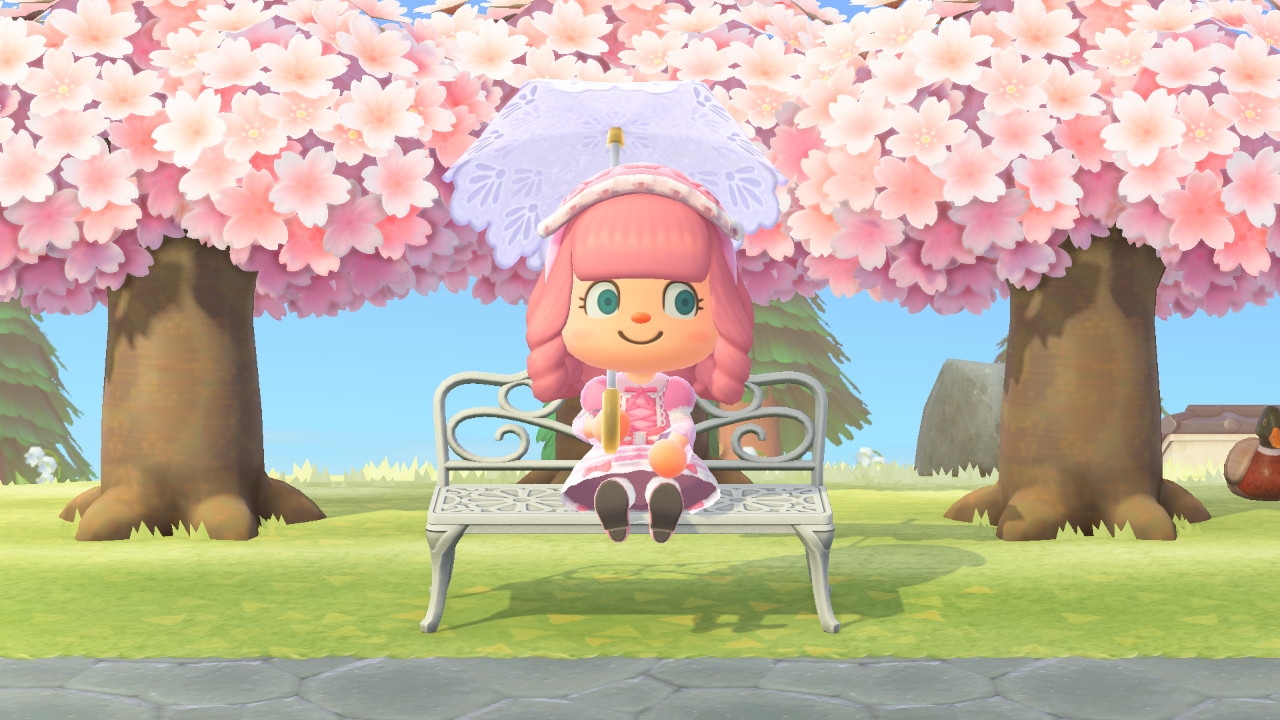
Here's where Animal Crossing comes in.  I decided to take pictures in my Lolita (Victorian/baby doll) dress that I got in Harajuku (Tokyo). I have always been a girly girl, but not too many people probably know it because it's not practical to always be dressed girly.  It's also a lot of work! I went through a period in elementary school where I only wanted to wear dresses. After Philip took my pictures, I remembered that they had a Lolita dress in Animal Crossing and so I decided to recreate my pictures in game!   


In game, there is a DIY you can make that is a pile of cherry blossom petals.


I didn't know before coming here that is a real thing! This happened naturally in my neighborhood.  


When the petals begin to fall, they truly do get blown by the wind.  I have been in parks where it is almost like a blizzard and so magical.  This video shows one of the piles blowing around in my neighborhood.  


What do you think? Would you like to visit Japan during sakura season?  

Thursday, March 16, 2023

Dear Diary

Dear Diary,

It's been three years since our lives changed forever. Three years ago in the beginning of March we did our last "normal" and "fun" trip we'd have for a long time. 

It was Spring break 2020 and we were living in the States. We decided to go to Disney World in Florida with my mother-in-law. I am SO, SO glad we did, for several reasons. Most obviously is because the world shut down right after that trip ended. Our last day at Disney World was on a Thursday and their last operating day was two days later on a Saturday. Like many, Philip left work for Spring Break with us and wouldn't return to the office until months later.  

It was such a scary time for everyone. The unknown loomed and threatened life as we knew it. SOOOO MANY PEOPLE DIED and our world WAS ALTERED FOREVER. 

Through this experience we learned a lot about different cultures.  Cultures that have a more individual focus couldn't stand the thought of doing something like mask wearing for other people because it was an an inconvenience for them.  Cultures that have a more societal focus had no problem masking up for the sake of others.  


Japan is in the latter group.  In fact, mask wearing is still VERY MUCH A THING.  It's been a while since the government said it's ok to be outside without a mask and yet 90% of people STILL MASK OUTSIDE! This week was an important day in government recommendations of masking.  Monday marked the day where masks are no longer required indoors or on public transportation when it's not crowded.  Masks are still "recommended" during crowded rush hours.

How much has changed this week?  The short story is, NOT MUCH.  I have seen a few more people than usual not wearing masks, but the majority is still masking.  I went to a festival this Wednesday and that was the first place I saw more than a handful of people not masking (outdoors).  I'll admit it, much to the chagrin of my foreign friends, if I am by myself I have usually been masking indoors.  I don't want to be looked at as that stupid foreigner, haha.  Outside, though, I am very much ok with not masking.  I still do it sometimes, though.  🤷

My group of foreigners was all for not masking at the festival this week!  


April 6 marks the new start of the school year in Japan. Masks will NOT be required then! I am hoping we'll see an uptick in unmasked people at that time. I am hoping the younger generation will help make the change towards not masking being the norm.  Many people have gotten comfortable hiding behind their masks, though.  Our international school will change their mask policy as well on March 31.  One of my children wants to unmask, the other not.  

So as most of the western world and even some of Asia has moved on and now says, "What pandemic?" Japan is very much still in the recovery phase. What do you think about this?  Would you be masked or unmasked if the majority of the people around you were masking?

Monday, February 27, 2023

Driving in Japan Part 2

Interesting randomness I have learned about driving in Japan in the last six months. 

Getting anywhere in a car takes just as long, if not LONGER than the ETA. No racing the GPS to see if you can beat the ETA (come on drivers, admit it, you've done it!). Most regular streets have a speed limit of 40 km/hour which converts to about 25 mph. Even smaller streets is 30 kmh (19 mph) and the widest streets or the expressway (toll road) are technically only 50 (31 mph) or 60 kmh (37 mph) (which almost no one goes and I have never seen anyone get a speeding ticket. The fastest speed limit posted I have seen is 80 kmh, which is about 50 mph!

Japanese people are some of the most patient people EVER. In daily life queuing up is something that they do without question and waiting for pedestrians and bikes to cross the street is completely normal and to be expected when driving. If you missed my first driving post talking about the driving test, check it out. There are a million safety and bike checks.

Japanese law favors the smaller vehicle over the larger vehicle. I.e, the pedestrian over a bicycle, or a bicycle over a car. I have a friend who told me she got in a minor accident with a bike when she was driving here and they basically told her, it's not your fault, but it's your fault. 

What do you think? Would you give driving a go in Japan? If you are from the the States, it is SUPER EASY to get an international driving permit.  All you do is go to AAA, show them your current driver's license, give or take a passport sized photo, pay $20 and BOOM, you're licensed to drive in most other countries (for one calendar year). 

Friday, February 17, 2023

Driving in Japan

It's very nerve wracking coming to a country that drives on the opposite side of the road. Not only that, the steering wheel is on the other side, and everything is flipped in the car. The first few times driving were the worst. I'd flip the windshield wipers on at least once a drive for a while, trying to turn on the blinker.  I also leaned to the left because I felt waaaay too close to things on my right side, since I was used to being on the other side of the car while driving.  

Here is the car we are leasing here in Japan.  It's called a Toyota Sienta.  Yes, Americans, you read that right. It's a Sienta, not Sienna.  It is technically a mini van, since it seats seven, but the third row of seats is quite small and there is no storage when they are in place.  When they are folded, they lay fairly flat, so it leaves us a lot of storage space for Costco trips and road trips.  We thought it would be a good car for driving guests around town or road tripping just our family around Japan.  


Looking in from the passenger's side of the car, the driver sits on the right side of the car, not on the left like in the States.

The driver's side. 

Everything is on the opposite side from cars in the States, including the blinkers, windshield wipers, and the automatic transmission gear shift. Thankfully, the gas and the brakes pedals are on the same sides at your feet! Otherwise that could be disastrous! 


The first time I drove in Japan it was on regular streets with an instructor from a driving school who was grading my EVERY move.  It was a month into our time in Japan and I hadn't driven at all since I left the States.  Philip drove first, he drives very cautiously, but even he got feedback from this driving instructor! We were both graded on our driving and we each received a "C" grade, hahaha! It was passing, though, so we got the OK to drive ourselves! 

To get a Japanese driver's license, we have to take both a written test and an actual driving test.  Instead of having a Department of Motor Vehicles (as California does), or  Department of Public Safety (as Texas does) each prefecture has their own driver's license centers.  Not sure why police is in the name, but I am guessing it's because all the teachers/testers are retired policemen.  
This is a stop sign.  

The relocation company supplied us with a Japanese driving handbook in English.

So many different signs, but thankfully most are similar to in those in the States.  
Probably the biggest difference in driving (besides being on the opposite side of the street and car) is the lights.  They have the same colors for stop, go, and slow; but this is a common sight and very confusing at first. In the States, arrows are reserved for turns and a circular red light is usually only used for straight through traffic and right turns (but sometimes a yield on left turn), but in the top photo, the arrow is being used for straight ahead drivers.  Turning in both directions have a red light.  In the bottom photo, everyone can go but right turns. 


Another big difference that doesn't warrant a photo is in the States it is OK to turn right (the direction of turn where you do no have to cross traffic) as long as you come to a complete stop and look to see if anyone is coming.  In Japan it is ILLEGAL to turn left (the direction of turn where you do not have to cross traffic). There is ONE exception.  If there is a blue arrow with a white background, you may turn on red.  I have yet to notice one yet here on the streets of Japan. Usually you see white arrows with a blue background, which indicates the direction of traffic movement (on a one way street).  

In order to convert your foreign licence to a Japanese license, you must take both a written and practical driving exam.  The written test is easy, it's mostly common sense and most people pass the first time.  The driving portion, however, is very difficult.  So difficult that the company will pay for us to take it TWICE. There are three courses for the driving test for foreign license conversion. You are supposed to memorize  all of them, but you won't know which course you will drive until the day of the test. The tester will tell you right or left, but not when to change lanes. 

The test is on a closed course. It has everything like in real life, such as traffic lights, stop signs, a simulated railroad crossing (transferring your license from another country doesn't cross this, but it should be noted that it's the law to make a full stop at a railroad crossing and look both ways before proceeding), crosswalks, curvy narrow roads (s curve), sharp narrow corners (the crank), parking spots (transfers of license do not have to park in the test, but it should be noted that it is customary to back in to any given parking spot), cones blocking the street, even a bridge for manual transmission tests (it is a separate test from automatic transmission). Unlike the driving tests in the States, the car is provided on your test day.  They are these really old Toyotas, which are made for driving tests and practices; the passenger even has a break.  

During the test itself, the testers are looking for a million safety checks (turn left blinker on and bike check then bike check again before you actually make a left at a green light, right left right, right left bike check right, right left right and crosswalk check, etc). They are also looking for your to get really close to the center line when making a right turn (a LOT of streets in Japan are NARROW), and really close to the curb on left turns as to not let a bike or scooter squeeze between your car and the curb since you would hit them while turning.  The larger vehicle is always at fault in Japan, i.e. the car when a bike is involved or a bike when a pedestrian is involved.  When changing lanes, you must first check the rear view mirror.  I don't think I have ever done that when changing lanes before; so first is rear view, side view on the side you want to change lanes, then blind spot check by actually turning your head, then look forward, and then finally change lanes.  I also got called out in practices for putting my hand inside the wheel to turn (hand pointing up) you must always have your hands in the 10 and 2 position and not reach inside the wheel.  

Neither Philip nor I passed the first time taking the test.  Philip passed the second time, which was great, because it didn't cost us personally any more money.  Unfortunately, I took a third time to finally pass.  The test itself is cheap (around $20 USD, but the lessons to practice with an instructor at the license test center to get tips and practice each of the three courses was more expensive (around $70 USD).  If I hired a translator through the relo company, that would be around $50 USD an hour, so taking the test a third time could have been very expensive. (I had to get there early to take an eye test, check in, and walk the course, with a 90 minute wait to get the results, so it would have been around 3.5 to 4 hours I'd have to pay the translator for). Fortunately for me, Philip was able to arrange his schedule so he could be my translator.  He really only needed to translate the feedback and what they informed me about after I received my actual license.  If I had done a fourth test, I might have tried going alone, but I am thankful I didn't need to worry about that.  

Something interesting we learned after I got my license is that if your foreign license expires during your stay in Japan, you can apply for an international license to use in your home country.  Our licenses from Texas will actually expire next year, so we will need to renew them (hopefully) online to keep them current.  What do you think of the process of transferring your license?  It seems overly complicated in some ways and several people I know personally have said it's a racket and that they are trying to make money off of us.  

Monday, February 13, 2023

Valentines Day in Japan

Happy Valentines Day from Japan!!!! Like most countries, Japan's looking for a reason to celebrate and spend money.  Valentines Day is no exception.  Interestingly, on Valentines Day, girls are supposed to give chocolates to the boys and then boys give them to the girls on White Day in March.  

These displays showed up in my local grocery store in January. I love how on my of their products (especially food) they have samples shown so you know exactly what you are getting.  

This is a full display.  Each type of chocolate has different size products available to fit any budget. 

They had chocolates available in many different styles.  


I bought Philip one of these Gundam chocolates.  


At a department store near Nagoya station, they held a Valentines Day Chocolate event. This was downstairs advertising it. 

This picture doesn't even do the chaos justice.  It was rows of chocolate makers selling all sorts of chocolates.  Most brands I have never even heard of. 

This one was one of the most amusing sellers.  Beetle, as in Volkswagon Beetle! They were selling VW Bug shaped chocolates!

I liked this one and thought of one of my good friends who loves green and camo.  

I'm a big Animal Crossing fan, as I have mentioned before.  I saw in one of my online groups that Godiva was doing a collaboration with Animal Crossing here in Japan! I couldn't resist going to get some for myself, lol.  Happy Valentines to me! 😂 They had an even bigger, round box of chocolates, but I got this one as it had the bag.  I couldn't justify buying both to myself. Hahaha!


These are the chocolates I bought for G and C. 


Philip likes Gundam, especially building them, so I couldn't resist buying him Gundam chocolates!


Hope you have a great Valentines Day!  Which chocolates were your favorite?

Simple Japanese Cooking

One of my friends asked me to share easy Japanese cooking, so here it is! I have bought all of these in Asian markets in the States. They wi...